
People-Pleasing: (Why) It’s Not Harmless and How it Hurts

We may wonder, what could be wrong with wanting to make others happy and to be likeable, or with being agreeable, helpful, and putting others' needs before one’s own? We teach our kids to be kind, thoughtful and polite and about empathy. However, there is a clear difference between being genuinely considerate and being a people-pleaser. While people-pleasing may seem harmless and even virtuous on the surface, it goes much deeper than just being "nice."
What Is People-Pleasing?
People-pleasing can be defined as a persistent pattern of prioritizing the (perceived or real) desires and expectations of others above one’s own in order to avoid upsetting or disappointing them. It is often rooted in a fear of disapproval, and in turn, rejection, stemming from an underlying insecurity tied to the belief that if I don't make this person happy, something bad will happen (e.g., he/she will stop liking/loving me). This form of anxiety leads to approval-seeking behaviors as a protective coping mechanism, an attempt to prevent and control outcomes. The distinction here with people-pleasing is the avoidance and fear that drives the behavior.
For example, I often hear something from young clients like: "I always play hopscotch with my friend at recess even though I think it's boring and want to try something new because I'm afraid if I tell her that, she'll be mad at me and not want to be my friend anymore."
While in this example, playing hopscotch could be viewed as being accommodating and a good friend, it's the part after the "because" that is key and keeps this person stuck.
The People-Pleasing Cycle
Here's an overview of what I see as the cycle that ensues that makes people-pleasing an often subconscious behavior pattern, what I will call the Anxiety-Avoidance Cycle of People Pleasing:
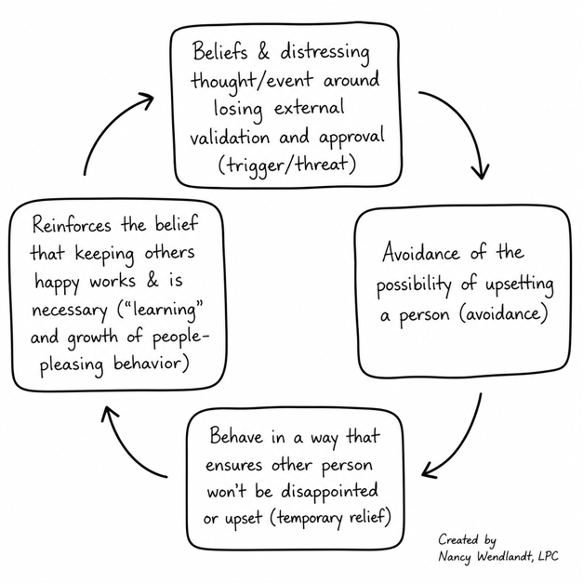
This cycle keeps them doing what they know "works" and from trying out alternatives, leaving them with limited opportunities to test out what actually happens if they don't engage in people-pleasing behaviors.
What are the Signs and Impacts of People-Pleasing?
As we can begin to see from the discussion above, people-pleasing can involve and lead to:
● Anxiety – worry about how others perceive them and if they have disappointed others
● Seeking external validation, approval and reassurance – looking to others for validation; self-esteem is tied to other's favorable view of them
● Low distress tolerance – perceiving someone is disappointed in them creates significant distress
● Conflict-avoidance – aim to prevent arguments and often act as peacekeepers, believing that harmony maintains relationships; perceive disagreement as a threat to acceptance and approval
● Low self-worth – belief that they are liked because of the people-pleasing behaviors and they have no way of knowing whether they are liked as their authentic selves
● Relationship patterns such as codependency – their role and value is in making others happy
● Feeling responsible for how others feel and self-blame and feelings of failure if others are upset
● Over-apologizing – apologize a lot, even when unnecessary
● Excessive agreeableness – use accommodation and compliance as a way to maintain relational security
● Identity confusion – feeling disconnected from and unsure of one's true self; lose sight of and may not be able to recognize and articulate their own desires and needs
● Suppression of own feelings
● Difficulty saying no, setting limits and establishing healthy boundaries
● Susceptibility to peer pressure, manipulation and abuse
● Limits growth
● Creates resentment and overwhelm
Contributing Factors
People-pleasing is a learned behavior. Environment and upbringing, cultural or family expectations, trauma, as well as genetic predisposition to mental health conditions that are corollary to people-pleasing, can play a role in its development. In some cases, people-pleasing is a learned survival strategy where appeasing someone was necessary for safety or stability, or where there was a lack of emotional safety and expression of feelings and needs was intolerable. It is also tied to negative core beliefs about one's self – such as the belief that one needs to earn the approval of others and is inherently not enough or worthy. Personality traits such as conscientiousness and high levels of empathy can also be linked to people-pleasing.
How The Mind Spot Can Help
Do you notice signs of people-pleasing in your child? The Mind Spot can work with your child to identify patterns of behavior, create awareness of beliefs that contribute to people-pleasing behaviors, and help your child develop the skills to create balance and change. Make an appointment with Nancy Wendlandt or one of our counselors today.Meet OurCounselors